
How Much Does “Popularity” Cost on Social Networking Sites?

Money cannot buy us true friendship in the real life, but can we buy fans or followers on social networking sites? Absolutely, and the price might be cheaper than expected.   

Eric Steuer reported the following price tags in Wired Magazine:
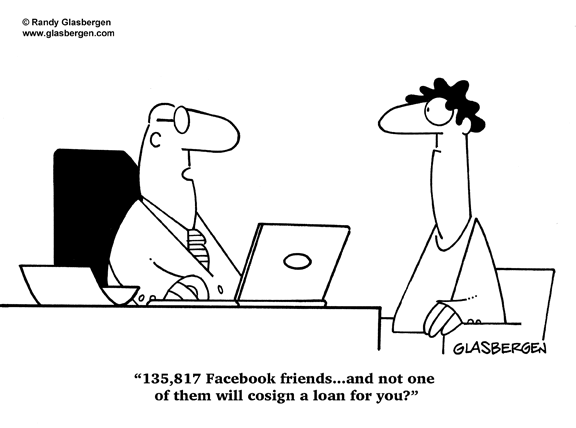
Facebook: 500 likes for $30 or 20,000 for $699 on Socialyup.com
Twitter: 1,000 followers for $10 or 1,000,000+ for $1,750 on FanMeNow.com
Pinterest: 100 followers for $15 or 5,000 for $95 on Pinfol.com
YouTube: 30,000 views for $150 or 1,000,000+ for $3,100 on 500views.com

I can certainly afford to pay $30 to make my Facebook page look better, but if I rarely engage the Facebook users on my page, how likely can I build a meaningful relationship with them? Without a meaningful relationship, can I create value for me and the Facebook users on my page? Probably not. That’s why I argued earlier that only the relationship built on engaging conversations can create value. Likewise, even though companies can buy thousands or millions of likes or followers, without engaging and meaningful conversations, company will not be able to convert the likes and followers into customers or sales.

What do you think of the act of purchasing fans or followers? Can we treat that behavior the same as cheating? If so, are the companies cheating the customers or potential investors? What suggestions will you provide to the companies who want to recruit (but not to buy) real fans and followers?

Relevant discussion:

References:
Steuer, Eric. (2013, April). Best friends$: No matter what social network you’re on, you can buy your way to popularity. Wired, p. 32.
The picture was downloaded from MalaysiaFinance.Blogspot.com

Comments

  1. Timelines for all to see. The former conman turned FBI consultant also warned against posting mug-shot buy instagram followers $5 style pictures that clearly show one’s face and recommends group photos instead.

    ReplyDelete

Post a Comment

Popular posts from this blog

Is It OK for Hotel Staff to Wear Piercings and Tattoos?

Time has changed. I see more and more college students wearing piercings and tattoos nowadays, but is it OK for hotel staff to wear piercings and tattoos? The answer is “no, no, no.” According a report at USAToday.com, customers across the board do not want to see any hotel workers with pierced eyebrow, pierced tongue, tattooed arm, or nose ring. Some may argue that tattooed and pierced workers may seem more acceptable in edgy boutique hotels as compared to the big franchised hotels, but the survey results did not find any differences among a variety of lodging products. Many respondents believe people who wear visible tattoos and piercings are taking a high risk of their professional lives. If you stay in a hotel, do you mind being served by tattooed and/or pierced staff? What if you are the one who makes the hiring decision? References: USAToday.com: http://tinyurl.com/linchikwok08042010 Picture was downloaded from http://tinyurl.com/linchikwok08042010P

Where Coffee Meets Culture: My Experience with Orientation, Socialization, and Culture at Dutch Bros (by Karina Martinez)

When people think of Dutch Bros, they usually picture colorful drinks, loud music, free stickers, and baristas so friendly they’ll jump in the car with you.  As someone who has had the opportunity to work for Dutch Bros, I can say that the energy customers feel isn’t an act; it is the result of intentional and effective HR practices that are focused on orientation, socialization, and culture. From your very first day, you experience how these practices shape the entire Dutch experience.  Orientation, Socialization, Culture   In HR management, orientation is the introduction of the role and company to new hires. This is intended to help them feel welcomed and informed. Socialization goes beyond the initial training process; it’s how new hires grasp the organization’s values, behaviors, and traditions over time. Together, these fun...

Average/Below-Average Looking People Can Earn as Much as the Attractive Ones

Research has shown that attractive people can not only charm interviewers (and thus get hired easier), they are also more likely to earn more as compared to those with average or below-average looks. Accordingly to a Wall Street Journal report , attractive people can earn 3% - 4% more than a person with below-average look. If such difference adds up over a person’s lifetime, an attractive person can earn up to $230,000 more than an ugly worker; even an average-looking person can make $140,000 more. Another relevant Wall Street Journal report also suggests that workers who exercise regularly can earn 9% more than those who do not. If that is the fact (I believe it is), is it legal? Can employers do that? Linchi Kwok and Otto @SyracuseU Career Fair To my knowledge, no law or regulation under EEOC (Equal Employment Opportunity Commission) considers a person’s look as a protective class. It is true that people in general have an idea of what kind of person they feel attract...